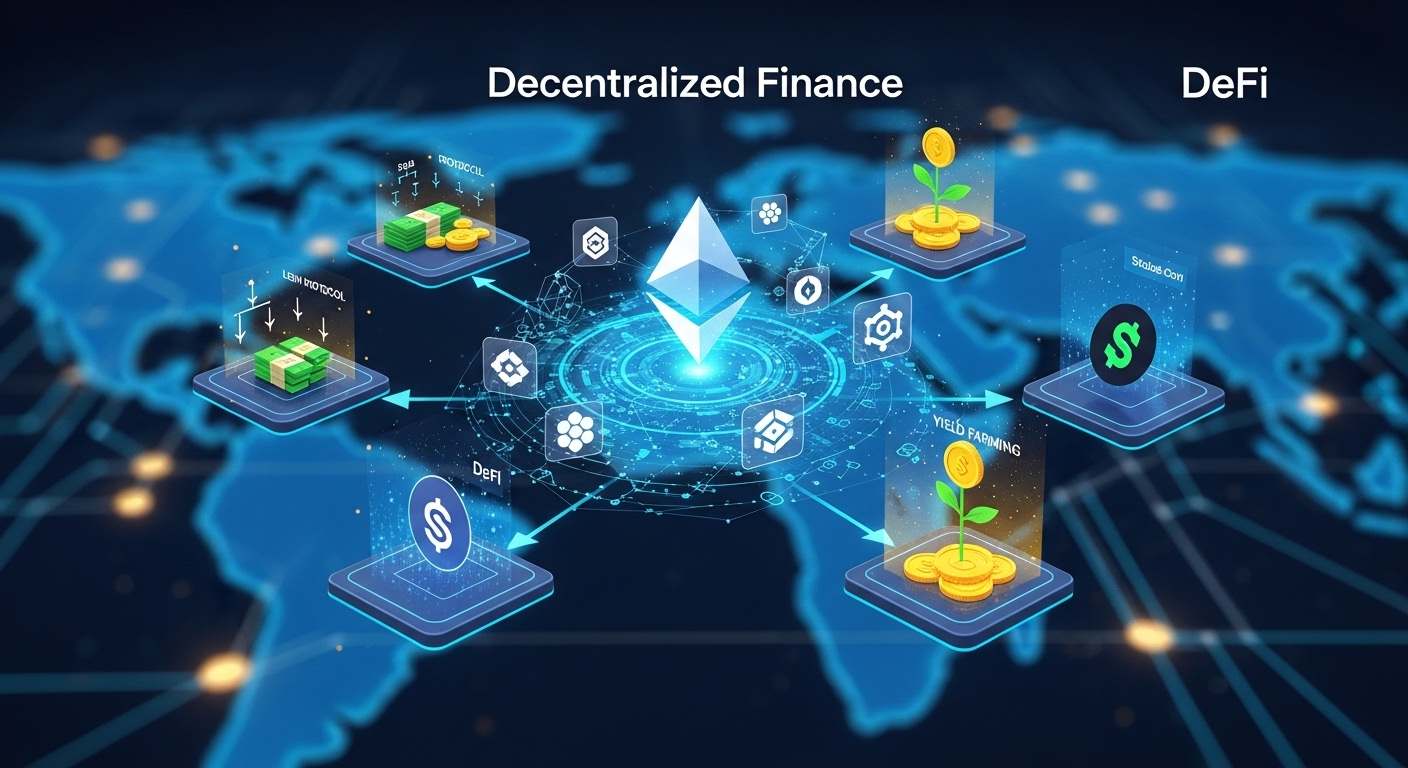
Decentralized finance, or DeFi, is one of the most important shifts introduced by blockchain technology because it reimagines financial services as open software rather than closed institutional systems. Ethereum.org defines DeFi as a set of financial products and services accessible to anyone with an internet connection, where markets stay open and transactions are handled by inspectable code instead of centralized authorities. The World Economic Forum describes it more broadly as the application of decentralized technology to financial services, emphasizing peer-to-peer settlement, programmability, composability, and the option for self-hosted custody. Together, those definitions capture the essence of DeFi: it is finance built on shared digital infrastructure rather than controlled by a single intermediary.
That idea matters because traditional finance still depends heavily on institutions that decide who gets access, when markets operate, how transactions settle, and what fees users pay. Ethereum.org contrasts this with DeFi by noting that in traditional systems, transfers may take days, access can be restricted, and intermediaries take a share of the value moving through the system. DeFi attempts to replace some of that friction with transparent smart contracts and direct wallet-based participation. It does not solve every financial problem, but it changes the architecture of the system in a way that many users and builders find compelling.
The scale of the sector shows that DeFi is no longer a niche experiment. DappRadar reported that DeFi reached a record $237 billion in total value locked in Q3 2025, even as user activity across some categories fluctuated. That figure should not be read as proof that all DeFi protocols are healthy or low-risk, but it does show that decentralized financial infrastructure now holds significant capital and plays a major role in the broader blockchain economy.
The core concepts behind DeFi
To understand DeFi properly, it helps to start with its foundational ideas. The first is self-custody. In many DeFi systems, users hold assets in their own wallets rather than depositing them with a bank or brokerage. The World Economic Forum identifies self-hosted custody as one of DeFi’s defining characteristics because it shifts control from institutions to users. That does not remove all risk, but it changes who is responsible for asset control and transaction approval.
The second is smart contract automation. Instead of relying on a back-office team to process rules, DeFi applications use blockchain-based code to execute actions automatically. Ethereum.org explains that many services that were previously slow and vulnerable to human error can now be handled by code that anyone can inspect. This matters because it makes financial logic more transparent and, in some cases, more efficient. A lending protocol can check collateral automatically. A decentralized exchange can settle trades according to predefined formulas. A staking system can distribute rewards without manual intervention.
The third is composability, which is one of DeFi’s most powerful traits. The World Economic Forum highlights DeFi’s programmable and composable architecture, meaning different applications can connect and build on one another. A user might deposit tokens into a liquidity pool, receive a receipt token, use that token in another protocol, and then earn rewards across multiple layers of the system. This “money Lego” structure is part of what makes DeFi innovative, but it is also part of what makes it risky, since one weak component can affect many others.
The fourth is permissionless access, at least in principle. Ethereum.org describes DeFi as open to anyone who can use Ethereum. In practice, regulations, wallet usability, fees, and geographic restrictions may still limit access. But compared with traditional systems that often require formal applications, local banking relationships, and institutional approval, DeFi lowers the barrier to participation for many users around the world.
How the DeFi ecosystem is structured
The DeFi ecosystem is not one application. It is a network of interrelated services. At the base are blockchains and execution environments, especially smart contract platforms such as Ethereum. On top of that base sit protocols that provide financial functions like lending, borrowing, trading, staking, derivatives, payments, and asset issuance. Around those protocols are wallets, bridges, analytics tools, governance systems, stablecoins, and developer infrastructure. Ethereum’s DeFi overview describes this as a booming crypto economy where users can lend, borrow, long, short, and earn interest through decentralized applications.
A major part of that ecosystem is decentralized exchanges, or DEXs. According to the World Economic Forum, DEXs let users swap one digital asset for another, with automated market makers adjusting prices in liquidity pools through smart contracts. This is a major structural shift from centralized exchanges, where trading is managed by an operator that controls custody, order matching, and platform rules. In DeFi, market activity can happen directly between wallets and protocol logic.
Lending and borrowing protocols form another central layer. The World Economic Forum notes that users can lend digital assets into pools and earn interest, while borrowers can access those assets after posting collateral. This model has become one of DeFi’s clearest use cases because it shows how financial intermediation can be handled through software rules rather than through traditional credit departments. These systems are especially effective in crypto-native settings where collateral can be monitored and liquidated automatically.
Stablecoins also play a crucial role. While the sources here focus more on DeFi’s structure than on stablecoin mechanics, stablecoins are fundamental because they reduce volatility inside DeFi workflows. Users often trade into stable-value assets, park liquidity in them, or use them as the unit of account for loans and settlements. Without relatively stable digital assets, much of DeFi would be harder to use for everyday financial activity. This is an inference from the way DeFi lending, trading, and settlement systems are designed and described in the cited sources.
This broader stack is one reason the market for specialized builders keeps growing. Teams launching new protocols are rarely building a single isolated app. They are designing contracts, wallet interactions, governance mechanisms, token economics, and integration layers all at once. That is why a defi development company is often expected to handle both technical execution and product architecture, not just coding.
Real-world applications of DeFi
The most established real-world application is decentralized trading. DEXs allow users to exchange assets directly from wallets without transferring funds to a centralized platform. This can reduce custody risk and create always-on global markets. Ethereum.org emphasizes that DeFi markets do not close at the end of the business day, which is a meaningful departure from many traditional financial venues.
Another major application is lending and borrowing. In conventional finance, access to credit depends heavily on institutional underwriting, identity checks, and jurisdiction-specific rules. In DeFi, collateralized lending can happen through programmable pools. This has been especially important for crypto-native users who want liquidity without selling their assets. The World Economic Forum specifically lists lending and borrowing as one of DeFi’s most common use cases, which reflects how central this function has become.
Yield generation is another widely used category. The World Economic Forum identifies yield farming and staking as prominent DeFi activities, where users earn passive income by supplying assets to protocols or by supporting blockchain operations. This appeal is simple but powerful: users are not only holding digital assets, they are putting them to work inside programmable financial systems. Still, reward mechanisms vary widely, and high yields often come with high protocol, liquidity, or token risks.
DeFi also has practical value in regions where financial instability or access barriers make alternatives attractive. Ethereum.org points to examples such as crypto-savvy Argentinians using DeFi to respond to inflation and companies streaming wages in real time. These examples show that DeFi is not only about speculation. In some contexts, it is used as a tool for value transfer, savings alternatives, and new payment flows that traditional systems do not easily offer.
In commercial settings, DeFi is increasingly relevant for tokenized assets, treasury management, onchain payments, and programmable settlements. The World Economic Forum argues that DeFi could support lower transaction costs and near-instant settlement, especially if interoperability and standards improve. That does not mean traditional finance will be replaced, but it does suggest that parts of financial infrastructure may gradually become more software-driven and more globally connected.
For companies entering this space, defi development services often need to cover far more than smart contract deployment. Teams need security reviews, wallet design, liquidity logic, compliance planning, user onboarding, analytics, and governance tooling. DeFi products are not simple websites layered over a token. They are financial systems, and users judge them accordingly.
The benefits and the tradeoffs
DeFi’s strongest benefits are openness, programmability, transparency, and speed. Ethereum.org highlights open access, user control over funds, and faster transfers compared with traditional payment rails. The World Economic Forum adds lower transaction costs, peer-to-peer settlement, and composable architecture to that list. These features help explain why DeFi has attracted developers, capital, and users across many regions.
But the tradeoffs are just as important. The World Economic Forum warns about regulatory gaps, cybersecurity risks, and financial instability risks such as rapid run-like dynamics. Smart contract vulnerabilities remain a central issue because a protocol can behave exactly as coded even if the code contains a serious flaw. On top of that, interconnected protocols can amplify failures across the ecosystem. This is one reason DeFi demands more caution than the “open finance” label sometimes suggests.
There is also the usability challenge. Self-custody gives users more control, but it also gives them more responsibility. Mistakes with private keys, wallet permissions, or protocol interactions can be costly and irreversible. DeFi is therefore more empowering than traditional finance in some respects, but also less forgiving. This tension is part of the reason mainstream adoption remains uneven even as the sector grows.
As DeFi matures, the sector will likely depend more on stronger standards, clearer risk controls, and better interoperability. The World Economic Forum explicitly argues that shared definitions and global standards are important for broader adoption and cross-border usability. That suggests the next stage of DeFi will not be driven only by code innovation, but also by how well developers, institutions, and regulators build frameworks around it.
Conclusion
DeFi is best understood as programmable finance built on decentralized infrastructure. It replaces some institutional functions with smart contracts, gives users more direct control over assets, and allows financial services to run in open, always-available digital environments. Its ecosystem includes trading, lending, borrowing, staking, liquidity provision, and many other services that now operate at meaningful scale. With DeFi TVL reaching $237 billion in Q3 2025, it is clear that decentralized finance has become a serious part of the digital asset economy.
At the same time, DeFi is not simply “traditional finance on blockchain.” It introduces a different model built around self-custody, composability, and software-based execution. That creates real advantages, but also new forms of risk. For businesses, developers, and users trying to navigate this space, the real opportunity lies in understanding both sides clearly. That is why demand continues to grow for teams that can act like a decentralized finance development company in the fullest sense: not just writing code, but building financial products that are secure, usable, and credible in real markets.