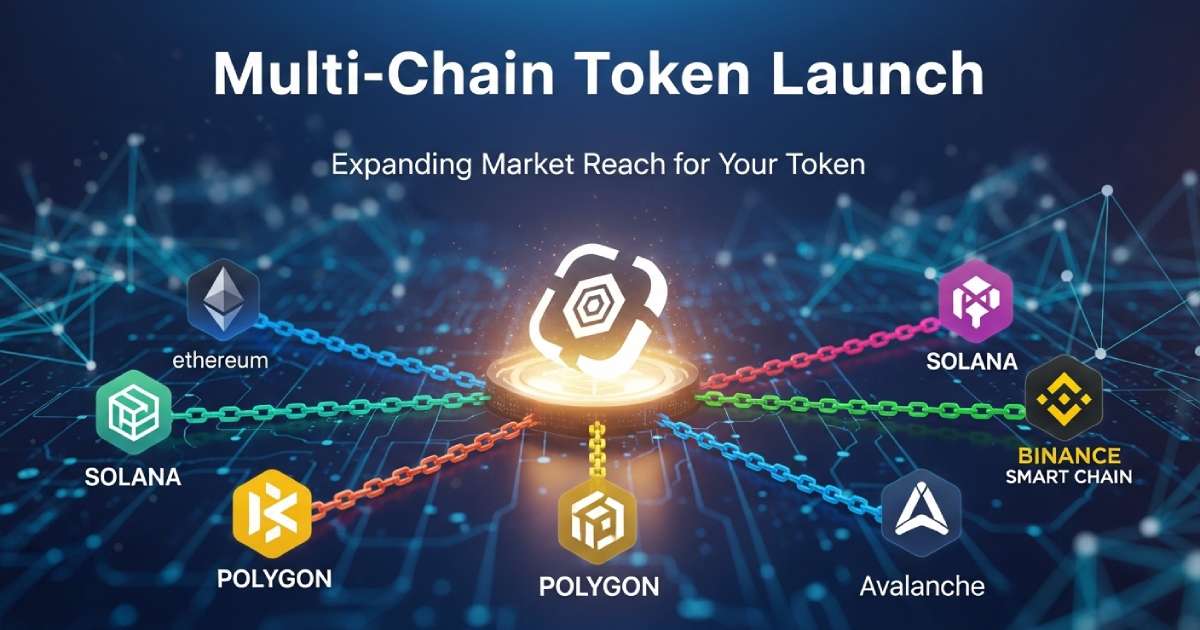
Launching a crypto token today is no longer limited to choosing a single blockchain and hoping for traction. The market has evolved. Users are spread across ecosystems, liquidity is fragmented, and investor attention shifts quickly between networks. In this environment, a multi-chain token launch has moved from being an advanced strategy to a practical necessity for projects aiming to scale beyond niche adoption.
A multi-chain approach allows a token to exist across multiple blockchains such as Ethereum, BNB Chain, Solana, and others, giving projects access to diverse user bases, liquidity pools, and application ecosystems. Instead of being confined to one network, tokens can move where users already are, making adoption more natural and growth more sustainable.
This article explores how multi-chain token launches work, why they matter, and how projects can use them effectively to expand market reach.
Understanding Multi-Chain Token Launch
A multi-chain token launch refers to deploying or enabling a token to operate across more than one blockchain network. This can be done through native deployments, wrapped tokens, or cross-chain bridges that allow tokens to move between ecosystems.
Rather than building exclusively on one chain, projects distribute their presence across several networks. Each chain contributes something different. Ethereum may offer strong DeFi infrastructure, BNB Chain may provide lower fees and faster transactions, while Solana can deliver high throughput for applications that require speed.
This approach shifts the focus from “which chain is best” to “how multiple chains can work together.”
How Multi-Chain Architecture Works
There are a few common ways multi-chain tokens are implemented:
Native Multi-Chain Deployment
The token is deployed separately on multiple blockchains with coordinated supply and tokenomics. Each chain hosts a native version of the token.
Bridged Tokens
Tokens exist on one primary chain and are wrapped or mirrored onto other chains using bridges. When a user moves tokens across chains, the original tokens are locked, and equivalent tokens are minted on the destination chain.
Cross-Chain Protocol Integration
Advanced projects integrate cross-chain messaging protocols that allow smart contracts on different chains to interact directly, enabling more complex use cases beyond simple transfers.
Each method comes with trade-offs in terms of security, complexity, and user experience.
Why Multi-Chain Token Launches Matter in 2026
The Web3 ecosystem has become increasingly fragmented. No single blockchain dominates every use case. Users are distributed across networks, and each ecosystem has developed its own culture, tools, and liquidity sources.
Launching on a single chain limits exposure. A multi-chain token development, on the other hand, aligns with how users actually interact with Web3 today.
Access to Diverse User Bases
Each blockchain ecosystem attracts a different type of user. Ethereum users often engage deeply with DeFi and NFTs, while BNB Chain users may prioritize low-cost transactions and retail participation. Solana attracts high-frequency users and gaming communities.
By launching across multiple chains, projects tap into all these segments instead of competing within one.
Improved Liquidity Distribution
Liquidity is no longer centralized. It exists across decentralized exchanges on multiple networks. A token that operates on only one chain may struggle to access broader liquidity pools.
Multi-chain tokens can:
- List on multiple DEXs across ecosystems
- Enable cross-chain trading opportunities
- Reduce dependency on a single liquidity source
This leads to more stable price discovery and better trading conditions.
Reduced Network Dependency
Relying on a single blockchain exposes projects to risks such as network congestion, high gas fees, or ecosystem slowdowns. Multi-chain strategies reduce this dependency.
If one chain experiences issues, users can continue interacting with the token on another network. This adds resilience to the project.
Expanding Market Reach Through Multi-Chain Strategy
Market reach in crypto is not just about visibility. It is about accessibility. A user cannot adopt a token if it is not available within their preferred ecosystem.
Multi-chain launches remove this barrier.
Presence Across Major Ecosystems
When a token is available on multiple chains, it becomes easier for users to interact without switching networks or learning new tools. This reduces friction and increases adoption.
For example, a user active on BNB Chain may never move to Ethereum just to use a token. But if that token is already available on BNB Chain, adoption becomes immediate.
Faster Community Growth
Communities in Web3 often form around ecosystems. By entering multiple ecosystems, projects can build parallel communities instead of relying on a single source of growth.
This creates:
- Broader awareness
- More active participation
- Stronger network effects
Enhanced Utility Across Platforms
Different chains support different types of applications. A multi-chain token can integrate with DeFi protocols on Ethereum, gaming platforms on Solana, and payment systems on BNB Chain.
This expands the token’s use cases and makes it more relevant across contexts.
Key Benefits of Multi-Chain Token Launch
Greater Accessibility
Users prefer interacting within familiar ecosystems. Multi-chain tokens meet users where they already are, removing the need for complex onboarding steps.
Stronger Liquidity Position
Liquidity spread across chains allows tokens to tap into multiple markets. This reduces slippage and improves trading experience.
Flexibility in Development
Projects can choose the best chain for specific features. For example, high-frequency transactions can run on faster chains, while governance mechanisms can remain on more secure networks.
Risk Diversification
By not relying on a single blockchain, projects reduce exposure to technical and market risks tied to one ecosystem.
Challenges in Multi-Chain Token Launch
While the benefits are clear, multi-chain strategies introduce complexity that must be managed carefully.
Cross-Chain Security Risks
Bridges and cross-chain protocols have been targets for exploits. Ensuring secure token transfers across chains is critical.
Projects need:
- Audited bridge solutions
- Secure smart contract design
- Continuous monitoring of cross-chain activity
Token Supply Management
Maintaining consistent token supply across chains can be challenging. Errors in minting or bridging can lead to imbalances.
Clear tokenomics and supply control mechanisms are essential to avoid inflation or duplication issues.
User Experience Complexity
Managing assets across multiple chains can be confusing for users, especially those new to crypto.
Projects must simplify this through:
- Unified interfaces
- Clear instructions
- Integrated wallet support
Choosing the Right Chains for Your Token
Not every project needs to launch on every blockchain. The choice should be strategic.
Factors to Consider
Target Audience
Identify where your users are most active. If your project targets DeFi users, Ethereum and Layer 2 networks may be ideal. For gaming, Solana or other high-speed chains might be better.
Transaction Costs
High fees can limit user participation. Including lower-cost chains can improve accessibility.
Ecosystem Compatibility
Ensure your token aligns with the applications and protocols available on the chosen chains.
Developer Tools and Support
Strong developer ecosystems make integration and scaling easier.
Real-World Examples of Multi-Chain Growth
Several successful projects have expanded through multi-chain strategies.
Tokens that initially launched on Ethereum later expanded to BNB Chain and Polygon to reduce fees and attract retail users. This shift often resulted in increased trading volume and broader adoption.
DeFi protocols have also embraced multi-chain deployments to capture liquidity across ecosystems. By doing so, they remain competitive and accessible regardless of where users choose to operate.
Multi-Chain Token Launch Process
A structured approach is essential for a successful multi-chain launch.
Planning Phase
Define the purpose of going multi-chain. Identify target ecosystems, user segments, and expected outcomes.
Token Design
Decide whether to use native deployments or bridged tokens. Ensure tokenomics remain consistent across chains.
Smart Contract Development
Develop and test contracts for each chain. Security audits are critical at this stage.
Bridge Integration
Choose reliable cross-chain solutions. Ensure smooth and secure token transfers.
Liquidity Setup
Provide liquidity on decentralized exchanges across selected chains. This ensures immediate usability after launch.
Community and Marketing Alignment
Each chain may require tailored messaging and community engagement strategies.
Advanced Strategies for Multi-Chain Token Launch
Launching across multiple chains is one part of the equation. The real advantage comes from how well those chains are connected, coordinated, and used to support growth. Projects that treat multi-chain as a structured strategy rather than a simple expansion tend to see stronger adoption and longer-term stability.
Unified Liquidity Strategy
Liquidity fragmentation is one of the biggest challenges in multi-chain ecosystems. If liquidity is spread too thin across chains, trading becomes inefficient and price differences can emerge.
Projects address this by:
- Prioritizing primary liquidity hubs on selected chains
- Using cross-chain liquidity protocols to balance pools
- Aligning incentives for liquidity providers across ecosystems
A focused liquidity plan ensures that expansion does not weaken market depth.
Cross-Chain Interoperability Design
Beyond token transfers, advanced projects enable interaction between smart contracts across chains. This allows users to perform actions on one chain that trigger outcomes on another.
For example, staking on one network could unlock rewards or access on another. This creates a connected experience instead of isolated ecosystems.
Ecosystem-Specific Utility Mapping
Each blockchain supports different use cases. A strong multi-chain strategy assigns specific roles to each network rather than duplicating the same functionality everywhere.
Ethereum may handle governance and high-value transactions
BNB Chain may support retail trading and payments
Solana may power gaming or high-speed applications
This approach keeps the token relevant across contexts while avoiding unnecessary duplication.
Marketing a Multi-Chain Token Launch
A multi-chain launch changes how marketing is executed. Instead of targeting a single audience, campaigns must adapt to multiple ecosystems, each with its own behavior and expectations.
Ecosystem-Based Positioning
Each blockchain community responds to different narratives. Messaging that works on Ethereum may not resonate with users on Solana or BNB Chain.
Projects need to:
- Customize messaging for each ecosystem
- Highlight chain-specific benefits
- Align communication with community culture
This creates stronger engagement within each network.
Multi-Channel Community Building
Community growth should mirror the multi-chain approach. Instead of one centralized group, projects often build presence across platforms tied to different ecosystems.
This includes:
- Telegram and Discord groups segmented by chain
- Chain-specific AMAs and community sessions
- Collaborations with ecosystem-native influencers
The goal is to create local relevance while maintaining a unified brand identity.
Coordinated Launch Campaigns
Timing plays a critical role. Launching on multiple chains requires coordinated campaigns to maintain momentum.
Projects often:
- Roll out phased launches across chains
- Announce listings and integrations sequentially
- Maintain consistent visibility across all ecosystems
This keeps attention sustained rather than fragmented.
Compliance and Regulatory Considerations
Operating across multiple blockchains introduces additional compliance layers. Each region and ecosystem may have different expectations around token distribution, marketing, and user onboarding.
Projects must consider:
Jurisdictional Marketing Rules
Marketing campaigns may need to be tailored based on regional regulations. Certain jurisdictions restrict how tokens can be promoted or sold.
KYC and AML Integration
For projects conducting token sales, integrating KYC and AML processes helps align with regulatory expectations and builds trust with investors.
Transparent Tokenomics
Clear communication around token supply, distribution, and usage becomes even more important in a multi-chain environment.
Consistency across chains ensures that users understand how the token functions regardless of where they interact with it.
Common Mistakes to Avoid
Even well-planned multi-chain launches can face issues if key aspects are overlooked.
Expanding Too Quickly
Launching on too many chains at once can dilute resources and reduce focus. It is better to start with a few strategic ecosystems and expand gradually.
Ignoring User Experience
Complex bridging processes and unclear instructions can discourage adoption. Simplicity should be a priority.
Weak Security Measures
Cross-chain systems increase the attack surface. Skipping audits or relying on untested solutions can lead to serious risks.
Inconsistent Messaging
Different messaging across chains can confuse users. A unified narrative with localized adjustments works better.
The Future of Multi-Chain Token Launches
The direction of Web3 points toward greater interoperability. Users are becoming less concerned with which chain they are on and more focused on what they can do.
Multi-chain strategies align with this shift.
Emerging developments such as cross-chain messaging protocols, modular blockchain architectures, and improved bridge security are making multi-chain operations more efficient and reliable.
Projects that adopt these models early are better positioned to scale as the ecosystem evolves.
Conclusion
A multi-chain token launch is not just a technical upgrade. It reflects a broader shift in how crypto projects approach growth, accessibility, and user engagement.
By expanding across multiple blockchains, projects gain access to diverse user bases, improve liquidity distribution, and reduce reliance on a single network. At the same time, they must manage added complexity in security, user experience, and coordination.
Success in multi-chain environments comes from balance. Strategic expansion, clear tokenomics, strong security practices, and ecosystem-aware marketing all play a role.
Projects that approach multi-chain launches with a clear plan and disciplined execution are more likely to build lasting traction in an increasingly fragmented Web3 landscape.